
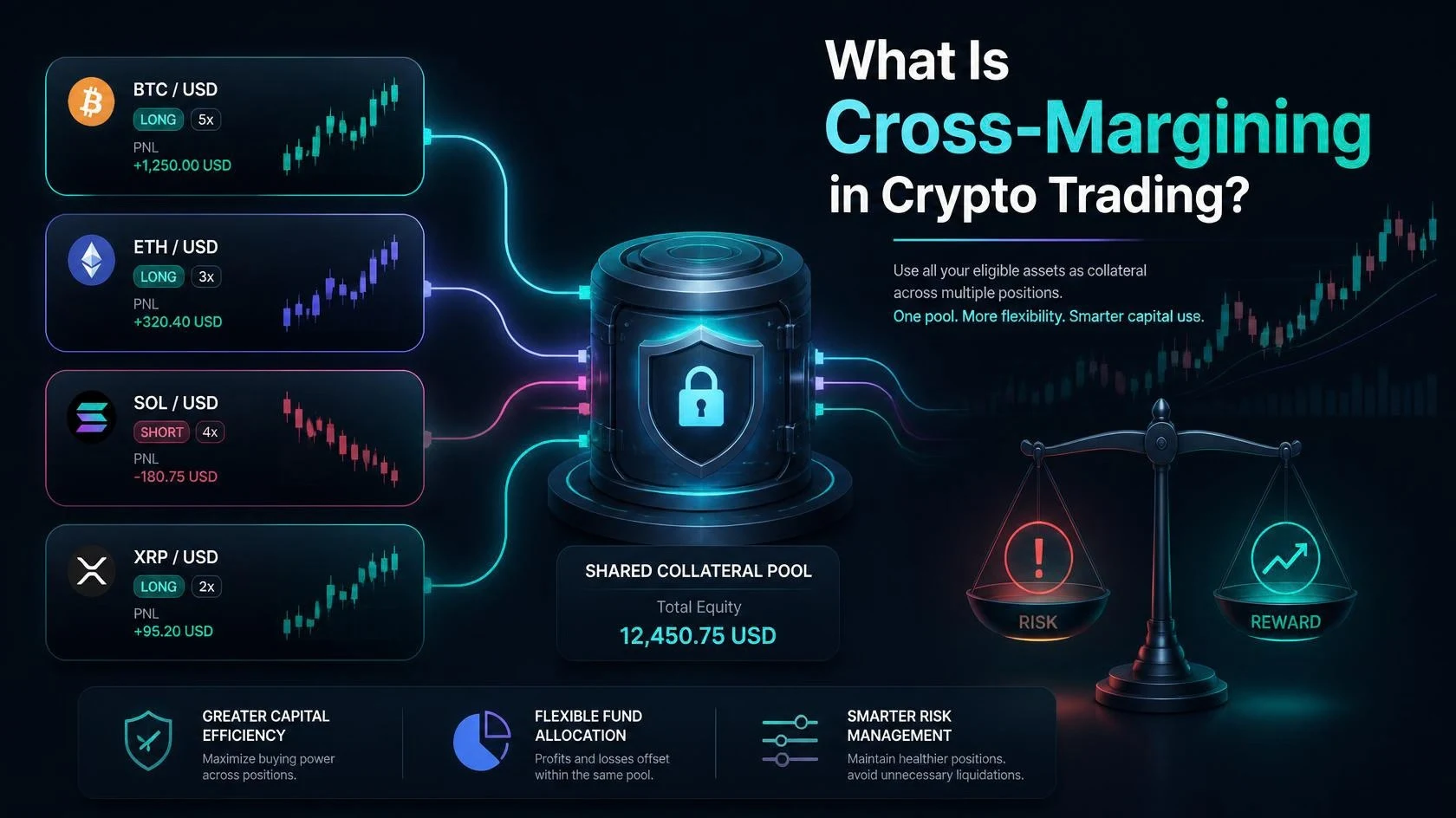
What Is Cross-Margining in Crypto Trading?
Open any crypto futures exchange, and you’ll find a small toggle sitting next to the leverage slider, usually labeled “Cross” or “Isolated.” It looks minor. It isn’t. That toggle decides whether a losing trade eats only the money you put behind it, or starts pulling from everything else sitting in your account.
Cross-margining is the “everything else” option. It pools your entire available balance into one shared pot of collateral, and every open position can draw on that pot to stay alive. Get the concept right, and it can save a position from a temporary wick. Misunderstand it, and a single bad altcoin trade can drain a balance you thought was untouched.
This guide walks through how cross-margining actually works, how it differs from isolated margin, what happens mechanically when a position gets into trouble, and the specific situations where each mode makes sense. We’ll also point you to a few outside resources worth bookmarking if you trade derivatives regularly.
A quick refresher on margin trading
Margin trading means putting up a portion of a trade’s value yourself and borrowing the rest from the exchange, so you can open a bigger position than your capital alone would allow. There are two numbers that matter here:
- Initial margin — the amount you need to open the position in the first place. If you’re using 10x leverage on a $1,000 position, your initial margin is $100.
- Maintenance margin — the minimum equity the exchange requires you to keep behind that position once it’s open. If your account equity drops below this line, the exchange either asks for more collateral or closes the position outright.
That second scenario — the exchange closing your position because equity fell too low — is a liquidation. Everything in this article is really about one question: which funds does the exchange draw on before it gets to that point, and how much room do you have before it happens?
How cross-margining Crypto Trading actually works
In cross-margin mode, your whole wallet balance for that settlement asset acts as shared collateral for every open position. If one trade starts losing, the exchange doesn’t close it the moment its own allocated margin runs out — it draws additional funds from your broader balance to keep the position open, as long as your total account equity stays above the maintenance requirement.
A simple example makes this concrete. Say you have 1,000 USDT in your futures wallet and open one BTC/USDT long using cross margin, putting 100 USDT toward it as effective margin. If the trade dips and that 100 USDT gets wiped out, the position doesn’t liquidate automatically. The exchange keeps it open by tapping into the remaining 900 USDT, which pushes your liquidation price further away and gives the trade more room to recover.
That’s genuinely useful during a brief flash crash — the kind of five-minute wick that reverses before most people have even noticed. It’s a different story if the price keeps falling in one direction, because now your entire 1,000 USDT balance is on the line for what started out as a 100 USDT bet. Isolated margin, by contrast, would have simply closed the position once the original 100 USDT was gone, capping your loss right there.
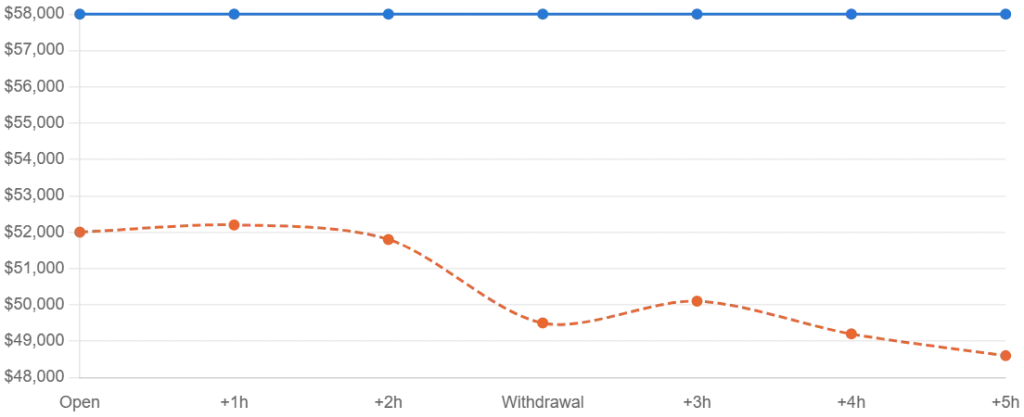
The core trade-off, stated plainly: cross margin trades a lower chance of getting stopped out on any single position for a higher chance that one bad trade drags down your whole account.
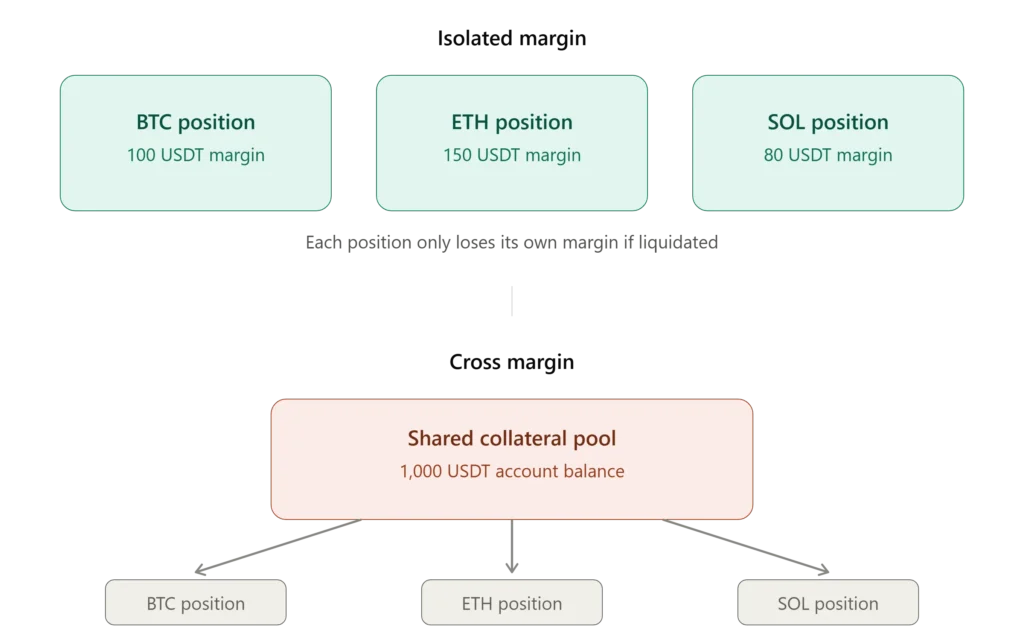
Cross margin vs. isolated margin, side by side
| Factor | Cross margin | Isolated margin |
|---|---|---|
| Collateral source | Entire account balance (per settlement asset) | A fixed amount you assign to that one position |
| Liquidation price | Moves dynamically as your balance and other positions change | Fixed once the position is opened |
| Maximum loss | Up to your full account balance in that asset | Capped at the margin you assigned to that trade |
| Best suited for | Hedged positions, correlated trades, experienced traders managing several positions at once | Beginners, single speculative trades, testing a new strategy |
| Main risk | A withdrawal or an unrelated losing trade can raise the liquidation price on everything else | A short-term price wick can liquidate a position that would otherwise have recovered |
| Typical user | Traders running a portfolio of positions with an eye on aggregate risk | Traders who want to know their exact worst case before they click “buy” |
Why traders actually use cross margin in Crypto Trading
Given the risks above, it’s fair to ask why anyone uses cross margin at all. The honest answer is hedging and capital efficiency.
Picture a trader who’s long Bitcoin and short Ethereum, betting on BTC outperforming ETH rather than predicting the direction of the whole market. If the market drops broadly, the short ETH position gains while the long BTC position loses. Under cross margin, those gains and losses net against each other inside the same collateral pool, which keeps the combined position stable even during a sharp move. Under isolated margin, each leg has to survive on its own separately allocated funds, so one leg can get liquidated even while the other is sitting on a profit that would have covered it.
Cross margin also removes a layer of manual work. Instead of topping up individual trades one by one during a volatile session, the whole balance adjusts automatically behind the scenes. For someone running several correlated or hedged positions at once, that’s a meaningful cut in the amount of active babysitting each trade demands — you’re managing one risk budget instead of five separate ones.
Where cross margin tends to go wrong
Correlated losses. Crypto assets often move together, especially during broad risk-off periods. If you’re long on three altcoins in cross margin and the whole market drops at once, all three positions draw from the same shrinking pool. Instead of one trade getting stopped out while the other two survive, liquidations can cascade through all three in quick succession.
Withdrawals. Pulling funds out of your futures wallet reduces the collateral backing every open cross-margin position, which quietly raises your liquidation price on trades you never touched. Traders have liquidated themselves this way without placing or closing a single order — the balance just wasn’t there anymore when the market tested it.
High leverage. Combining cross margin with very high leverage removes most of the safety cross margin is supposed to provide. At 50x or 100x, even a small move can consume the entire pool regardless of how large your account balance looks on paper.
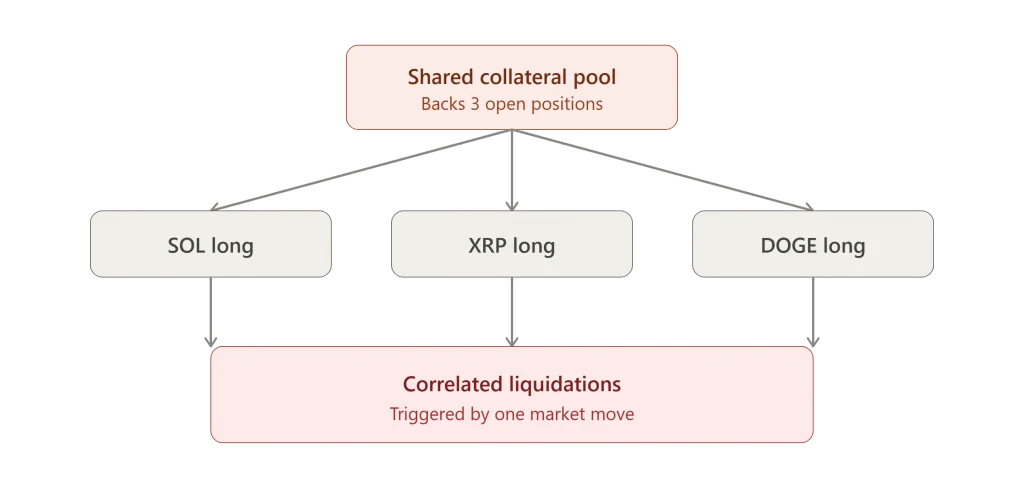
A rule worth remembering: cross margin protects a trade from short-term noise. It does not protect your account from a sustained move in the wrong direction.
What actually happens during a liquidation
It’s worth understanding the mechanics past the word “liquidation” itself, because exchanges rarely just flip a switch and take everything.
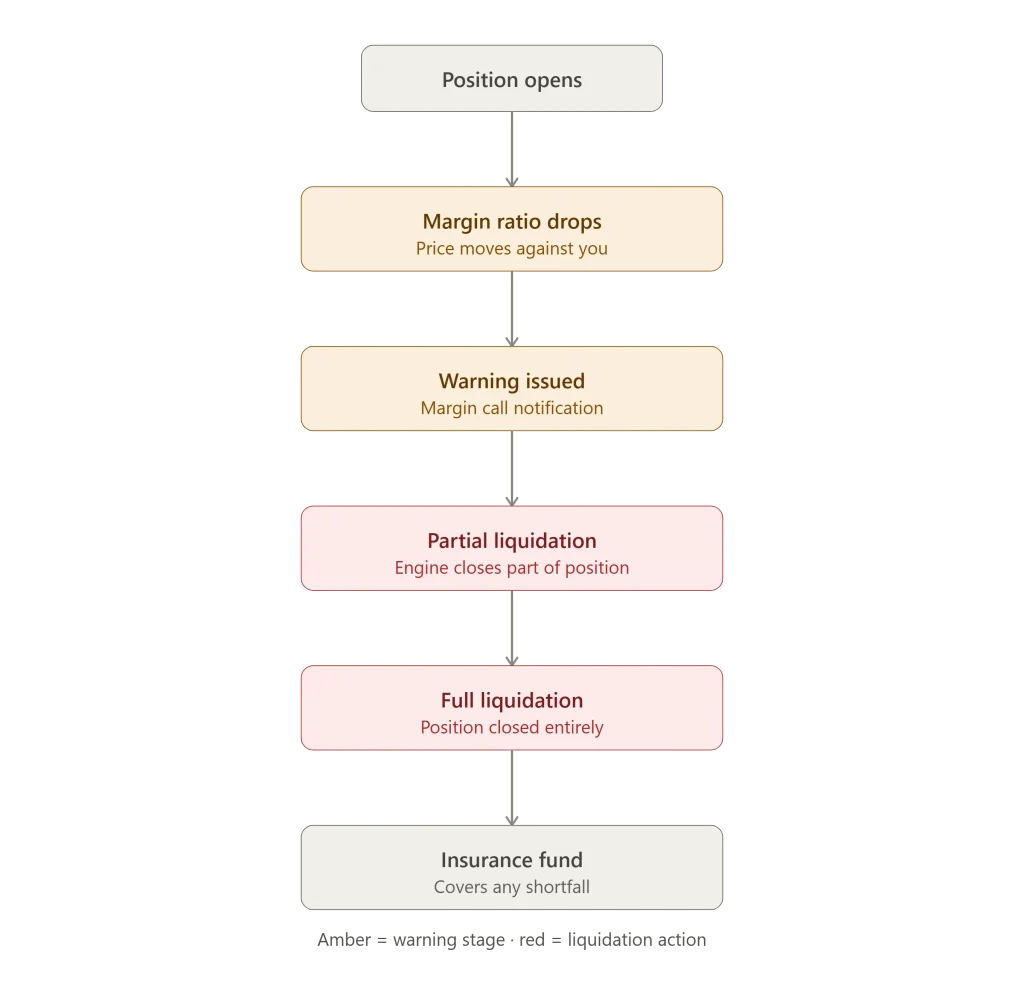
Most platforms use a tiered process. As your margin ratio deteriorates, the exchange typically issues a margin call or warning first (often just a notification, not a phone call), giving you a window to add funds or reduce position size. If equity keeps falling and crosses the maintenance threshold, the exchange’s liquidation engine steps in — on many platforms this starts with a partial liquidation, closing enough of the position to bring your margin ratio back to a safer level rather than closing everything at once. Only if the position keeps deteriorating, or the market gaps too fast for a partial close to keep up, does a full liquidation occur.
Behind that sits an insurance fund on most major exchanges, designed to absorb the gap when a position gets closed at a worse price than its bankruptcy price. When the insurance fund itself is insufficient to cover the shortfall, some platforms fall back to auto-deleveraging (ADL), which forcibly reduces profitable traders’ positions on the opposite side of the trade. It’s a mechanism worth knowing exists even if you never encounter it directly.
A simple way to decide between the two
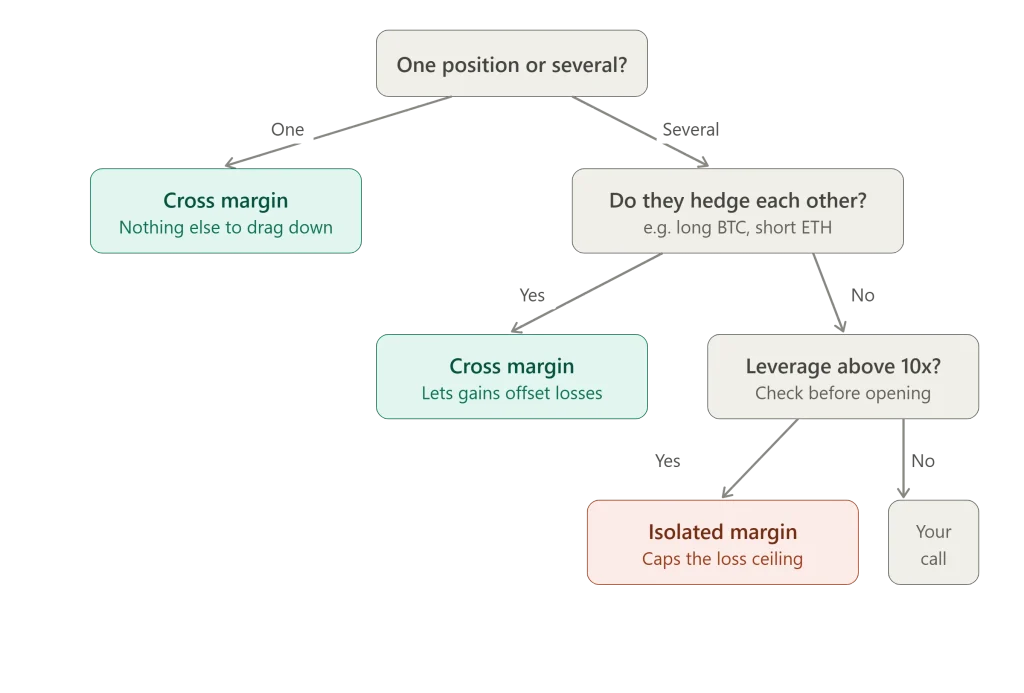
There’s no universal answer, but a few questions tend to point most traders in the right direction:
- Are you running one position or several? A single, well-sized position is often fine under cross margin, since there’s nothing else it can drag down.
- Are your positions hedging each other? If a loss on one trade is meant to be offset by a gain on another, cross margin lets that offsetting actually happen.
- What leverage are you using? The higher the leverage, the more a small move eats into your buffer — and the more isolated margin’s fixed loss ceiling starts to matter.
- Will you be watching the position? If you’re stepping away from the screen for hours, isolated margin limits the damage a black-swan move can do while you’re not there to react.
Exchange behavior varies — check before you trade
Not every platform implements cross-margining identically. Some pool collateral across your entire portfolio regardless of asset; others only pool positions settled in the same currency, keeping USDT-margined and coin-margined contracts separate. A few platforms let you switch a single open position between cross and isolated mode on the fly, while others require you to close the position first and reopen it under the new mode. Binance Academy’s explainer on isolated and cross margin is a solid starting point for understanding one major exchange’s implementation, but always read the specific platform’s own margin documentation before assuming how it behaves — the mechanics genuinely differ enough to matter.
It’s also worth understanding how funding rates interact with open perpetual futures positions. These periodic payments between longs and shorts add to or subtract from your account balance regardless of which margin mode you’re using, and during periods of extreme funding, they can shift your liquidation buffer meaningfully even while the underlying price barely moves.
A few risk management habits worth adopting
Regardless of which mode you use, a handful of habits meaningfully reduce how often you get surprised:
- Keep a buffer above your liquidation price, not just above zero. A position that’s technically still open but three ticks from liquidation isn’t meaningfully safer than one that’s already closed.
- Check your margin ratio before withdrawing, not after. Most exchanges show this number on the same screen as your withdrawal button — glance at it first.
- Size positions against your whole account, not just the margin you’re putting up. In cross margin, your real exposure is your full balance, not the 100 USDT you allocated mentally to one trade.
- Set a price alert near your liquidation level, separate from the exchange’s own warnings, so you’re not relying on a single notification system during a volatile stretch.
- Review correlated positions as a group, not individually. Three altcoin longs aren’t three independent risks — in a downturn, they tend to behave like one large risk.
Further reading
A few outside resources worth bookmarking if you want to go deeper:
- Binance Academy — What Are Isolated Margin and Cross Margin? — a walkthrough of how one major exchange implements both modes.
- Investopedia — Funding Fee — background on how funding rates work in perpetual futures and why they matter alongside margin mode.
- FINRA — Margin Disclosure Statement (PDF) — written for traditional securities margin accounts, but the underlying risk principles (you can lose more than you deposit, the broker can act without prior notice) apply directly to crypto derivatives too.
- CFTC — Customer Advisory: Understand the Risks of Virtual Currency Trading — a U.S. regulator’s plain-language advisory on leverage and volatility risk specific to crypto markets.
Frequently asked questions
Is cross-margining the same on every exchange?
No. Some platforms pool your entire account balance across every asset; others pool only positions that settle in the same currency. Always check the exchange’s own margin documentation before assuming how it behaves.
Can you lose more than your deposit with cross margin?
On most retail crypto exchanges, no. The platform automatically liquidates positions once account equity falls to the maintenance margin level, so losses are capped at your account balance rather than turning into a debt — unless the specific platform explicitly permits negative balances, which is uncommon for retail accounts.
Does withdrawing funds affect open cross-margin positions?
Yes. Withdrawing funds reduces the collateral pool backing your open positions, which raises your liquidation price. This catches out more traders than you’d expect, since the connection between “withdraw” and “liquidation price” isn’t obvious from the withdrawal screen itself.
Should beginners use cross margin?
Most exchanges and experienced traders point beginners toward isolated margin, since it caps the loss on any single trade while you’re still learning how leverage behaves. Cross margin tends to suit traders running hedged or multi-position strategies who already understand how shared collateral moves.
Can you switch between cross and isolated margin on an open position?
On some exchanges, yes, in real time. On others, you need to close the position first. This is one of the clearest examples of why reading the specific platform’s documentation matters more than general explainers — the mechanics really do vary.
Does cross margin affect how funding rates are paid?
Not directly. Funding payments are typically settled per contract regardless of margin mode. What changes is how that payment interacts with your buffer: in cross margin, a funding payment simply adjusts your shared pool; in isolated margin, it adjusts the fixed amount allocated to that specific position.
The bottom line
Cross-margining isn’t inherently riskier or safer than isolated margin — it just redistributes where the risk sits. Isolated margin puts a hard ceiling on a single trade. Cross-margining puts a soft, shifting ceiling on your whole account. Neither one replaces basic risk management: sizing positions sensibly, understanding your leverage, and knowing exactly what happens to your collateral before you open a trade, not after.
This article is for informational purposes only and does not constitute financial or investment advice. Margin and leverage trading carry a high risk of loss. Always do your own research and consider your risk tolerance before trading crypto derivatives.