
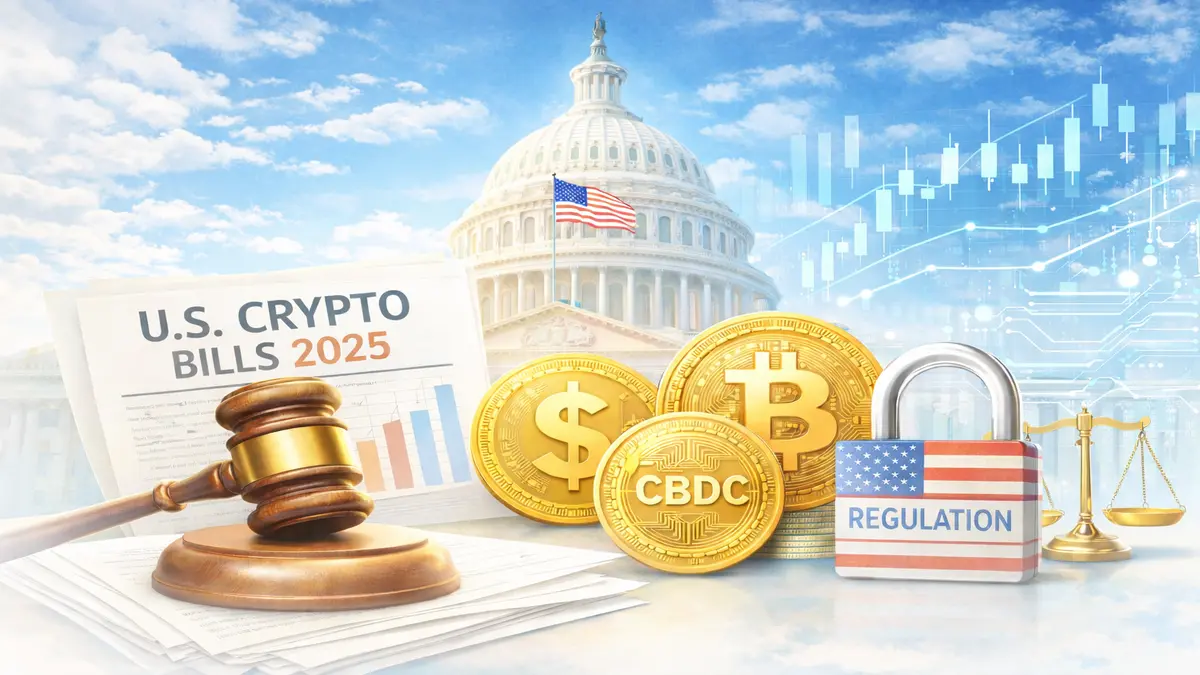
U.S Crypto Bills in 2025: Stablecoin Rules, CBDC Limits & Market Reform
In 2025, the U.S. took arguably its most decisive steps yet toward establishing a federal framework for cryptocurrency regulation. After years of enforcement-focused actions and regulatory uncertainty, lawmakers delivered landmark bills that reshape how digital assets are regulated, particularly around stablecoins, market structure, classification, and digital currencies issued by central banks.
This article breaks down the key legislation, explains its implications for crypto markets and participants, and highlights how these changes are positioning the U.S. in the global digital asset landscape.
Table of Contents
📍 What Shifted in 2025?
Before 2025, digital asset regulation in the U.S. was fragmented, with the Securities and Exchange Commission (SEC) and the Commodity Futures Trading Commission (CFTC) largely split in their responsibilities, providing limited guidance on stablecoins and little legislative clarity on digital asset classifications.
In 2025, Congress moved past proposals and turned principles into law, with a legislative push sometimes referred to on Capitol Hill as “Crypto Week.
The key outcomes:
✔️ A federal regulatory framework for stablecoins
✔️ Clearer market structure and asset classification rules
✔️ Limits on a retail-CBDC (Central Bank Digital Currency) without Congress’s approval
✔️ Momentum toward harmonizing agency jurisdiction
🧾 Major Crypto Bills & Policies in 2025
Here’s an overview of the most important legislation and policy shifts that defined the U.S. crypto agenda in 2025:
| Bill / Policy | Purpose | Status | Notes |
|---|---|---|---|
| GENIUS Act | Federal stablecoin framework | Passed & signed into law | First major U.S. stablecoin law, standardizes reserves & issuer requirements. Wikipedia |
| CLARITY Act | Market structure & regulatory jurisdiction | Passed House, moving in Senate | Clarifies which tokens fall under SEC vs CFTC authority. TRM Labs |
| Anti-CBDC (Anti-Surveillance State) Measures | Restricts Fed from issuing retail CBDC | Passed House* | Prioritizes privacy and legislative control over digital fiat. Congress.gov |
| Executive Order 14178 | Defines national stance on digital assets | Signed Jan 2025 | Signals strategic priority and sets regulatory groundwork. Wikipedia |
*Note: While many market structures and CBDC-related provisions have advanced, some require final passage in the Senate.
🧠 The GENIUS Act: A Game Changer for Stablecoins
The most consequential legislation this year was the Guiding and Establishing National Innovation for U.S. Stablecoins Act, commonly known as the GENIUS Act.
🪙 What It Does
- Creates the first comprehensive federal regulatory regime for payment stablecoins. The White House
- Requires 100% high-quality liquid reserve backing — typically U.S. dollars or short-term Treasuries. The White House
- Establishes transparent monthly disclosures on reserve composition. The White House
- Clarifies issuer eligibility and licensing across federal and state authorities. Wikipedia
📌 Why it matters: For businesses and institutional users, this brings legal certainty around stablecoin issuance and operation — a longstanding barrier to adoption.
🧩 Understanding Market Structure Reform
A significant part of 2025’s legislative agenda wasn’t just stablecoins — it was where crypto fits in the broader financial system.
What Market Structure Reform Is Aiming For
- Defines when assets are securities vs commodities
- Clarifies agency jurisdiction (SEC vs CFTC)
- Establishes registration and operational standards for exchanges, brokers, and custodians
This is rooted in bills such as the CLARITY Act, which passed the House and heads to the Senate. TRM Labs It complements long-running efforts like the Financial Innovation and Technology for the 21st Century Act (FIT21), which similarly aims to organize regulatory authority.
🏦 CBDC Policy: What Congress Decided
While some nations accelerate their central bank digital currency (CBDC) efforts, Congress raised limits on U.S. CBDCs in 2025.
- Legislation and executive actions restricted the Federal Reserve from launching a retail CBDC without explicit congressional approval.
- Policymakers emphasized privacy safeguards and legislative oversight.
This reflects broader skepticism toward centralized digital currency models unless paired with robust privacy and consumer protections.
📊 Visual Overview: 2025 Regulatory Shift
Stablecoin Regulation Progress — 2025 Snapshot
| Milestone | Impact |
|---|---|
| GENIUS Act signed | Federal stablecoin framework established |
| Market structure bills moved | Clarification on token treatment |
| CBDC restrictions passed | Limits the central bank’s digital currency rollout |
| Executive order for crypto policy | Strategic foundation for regulation |
📌 What This Means for Crypto Stakeholders
For Regulators
- A move toward uniform, transparent federal rules
- Regulatory responsibilities become easier to enforce
For Businesses & Developers
- Clear licensing paths and supervision models
- Reduced legal risk for launching compliant products
For Investors & Users
- Stronger disclosures and consumer safeguards
- More predictable legal environment
📚 Further Reading
- U.S. stablecoin law — GENIUS Act (Wikipedia)
👉 https://en.wikipedia.org/wiki/GENIUS_Act - How crypto regulation works globally — Britannica: Cryptocurrency Regulation
👉 https://www.britannica.com/money/cryptocurrency-regulation - Overview of U.S. legislative developments — Crypto Policy Tracker
👉 https://www.lw.com/en/us-crypto-policy-tracker/legislative-developments
In Summary
The U.S. crypto regulatory landscape in 2025 shifted from ambiguity to structure and certainty. With the GENIUS Act setting stablecoin standards and other bills clarifying market roles and CBDC policy, the U.S. is moving closer to a balanced, innovation-friendly regulatory ecosystem that still prioritizes consumer protection and market integrity.
Frequently Asked Questions (FAQs)
-
What are the U.S. crypto bills passed in 2025?
The U.S. crypto bills passed in 2025 include legislation focused on stablecoin regulation, digital asset market structure, and restrictions on central bank digital currencies (CBDCs). The most notable law is the GENIUS Act, which establishes federal rules for stablecoin issuers and reserve requirements.
-
What is the GENIUS Act, and why is it important?
The GENIUS Act (Guiding and Establishing National Innovation for U.S. Stablecoins Act) is the first comprehensive U.S. law regulating stablecoins. It requires full reserve backing, transparency in disclosures, and clear licensing rules, helping reduce risk and improve trust in dollar-pegged stablecoins.
-
How do the 2025 crypto bills affect stablecoins in the U.S.?
The new laws require stablecoins to be backed by high-quality liquid assets like U.S. dollars or short-term Treasuries. Issuers must meet strict reporting and compliance standards, which increases consumer protection and reduces the risk of stablecoin collapses.
-
Do the 2025 U.S. crypto bills ban CBDCs?
No, the bills do not completely ban CBDCs. However, they limit the Federal Reserve from issuing a retail CBDC without explicit approval from Congress, citing concerns over privacy, surveillance, and government overreach.
-
How do these bills change crypto regulation in the U.S.?
The 2025 legislation shifts U.S. crypto regulation from enforcement-driven actions to a clearer rule-based framework. It defines regulatory roles, improves oversight, and offers businesses clearer compliance pathways instead of legal uncertainty.
-
Who regulates crypto under the new U.S. framework?
Under the updated framework, regulatory authority is more clearly divided between the SEC and the CFTC, depending on whether a digital asset is classified as a security or a commodity. This reduces overlap and confusion for crypto projects and exchanges.
-
What do the 2025 crypto bills mean for investors?
For investors, the new bills provide stronger safeguards, clearer disclosures, and reduced regulatory uncertainty. While compliance costs may rise for crypto companies, the overall market is expected to become more transparent and stable.
-
How do the U.S. crypto bills compare to global regulations?
The U.S. approach in 2025 focuses on stablecoin oversight and market structure rather than broad bans. This contrasts with regions like the EU, which implemented MiCA, and positions the U.S. as a more innovation-friendly but regulated crypto market.
-
Will these laws affect decentralized finance (DeFi)?
Most 2025 crypto bills primarily target centralized stablecoin issuers and intermediaries. However, DeFi platforms that rely heavily on regulated stablecoins may need to adapt to new compliance and liquidity requirements.
-
Why are U.S. crypto bills in 2025 considered a turning point?
The 2025 bills mark the first time the U.S. established clear federal rules for key parts of the crypto ecosystem. This shift from uncertainty to structure signals long-term commitment to digital asset innovation while prioritizing financial stability and consumer protection.