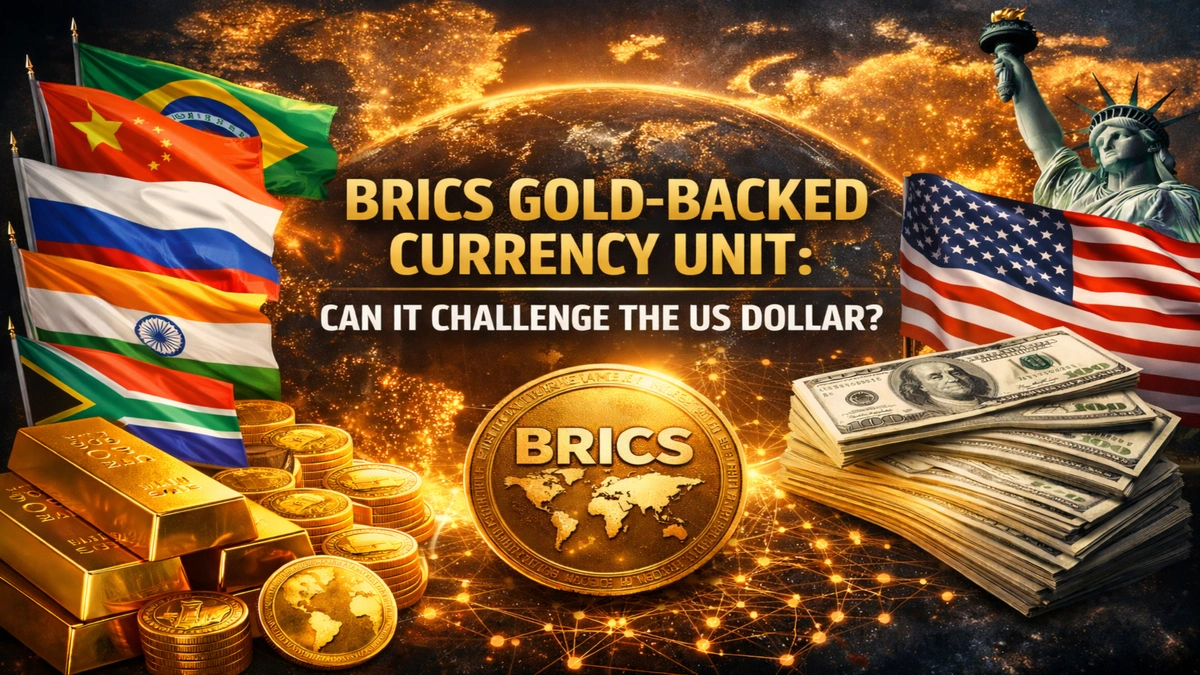
BRICS Launch Gold-Backed Currency Unit: Can It End Dollar Dominance?
The BRICS bloc (Brazil, Russia, India, China, South Africa – now expanded to 11 countries) has quietly debuted a pilot digital currency called the Unit. Announced in December 2025 by Russia’s International Research Institute for Advanced Systems (IRIAS), the Unit is a gold-backed trade currency designed to settle cross-border transactions within the BRICS alliance. Each Unit is backed 40% by physical gold and 60% by a basket of BRICS currencies (Brazilian real, Chinese yuan, Indian rupee, Russian ruble, and South African rand).
The Unit is not intended for consumer use. Instead, it functions as a blockchain-based settlement token. Built on the Cardano network, the Unit is governed by a new international Unit Foundation. In a twist fit for 2025, the foundation even appointed an AI as its executive director to ensure neutrality and transparency.
Table of Contents
The Basics: What Exactly Is “The Unit”?
Picture this: Five major economies (Brazil, Russia, India, China, South Africa) and their new partners want to trade billions in goods—oil from Russia, tech from China, minerals from Africa—without the middleman fees and sanctions risks of dollar-denominated deals. Enter The Unit, a blockchain-based prototype cooked up by Russia’s Institute for Economic Strategies (IRIAS).
Launched in a low-key “Pumpkin Batch” test on October 31, 2025, The Unit started life pegged at one gram of gold per unit. By early December, market jitters had nudged it down to about 0.98 grams, showing it’s built to flex with real-time values. It’s not for your everyday coffee run; this is institutional-grade stuff for governments and banks, running on Cardano’s permissioned blockchain for quick, secure settlements.
At its core, The Unit’s value draws from a simple basket:
As of the December 2025 update, the pilot’s basket was valued at 98.23 grams of gold total, reflecting a slight depreciation from currency fluctuations. IRIAS, the overseer, emphasizes its role in boosting gold liquidity while allowing countries to retain physical reserves domestically. The Unit Foundation, which proposed the model, has appointed an AI “CEO” to govern decisions impartially, underscoring a commitment to neutrality.
| Component | Weight | Role | Example in Pilot (100 Units) |
|---|---|---|---|
| Gold | 40% | Stability Anchor | 40g total; daily repricing |
| Real (Brazil) | 12% | Representation | Portion of basket deposit |
| Yuan (China) | 12% | Representation | Portion of basket deposit |
| Rupee (India) | 12% | Representation | Portion of basket deposit |
| Ruble (Russia) | 12% | Representation | Portion of basket deposit |
| Rand (South Africa) | 12% | Representation | Portion of basket deposit |
This table highlights the balanced design, which differentiates the Unit from volatile cryptocurrencies or unbacked stablecoins.
This hybrid setup aims for stability without the volatility that plagues pure cryptos. For a deeper dive, check out this detailed breakdown from IntelliNews.
Technical Architecture: The 40/60 Reserve Framework
At the heart of The Unit is a hybrid valuation model designed to provide both the stability of hard assets and the liquidity of sovereign currencies. The framework operates on a dual-asset foundation:
- 40% Physical Gold: This portion acts as a “hard anchor.” In initial test phases, the Unit was valued against 40 grams of physical gold. By anchoring nearly half the unit’s value to gold, the BRICS bloc aims to create a “natural resistance” to inflation and currency volatility.
- 60% BRICS Currency Basket: The remaining value is derived from a basket of local currencies from the core members: the Brazilian Real, Russian Ruble, Indian Rupee, Chinese Yuan, and South African Rand. This basket is adjusted periodically to reflect bilateral trade volumes and economic shifts within the bloc.
Unlike a traditional fiat currency, the Unit is not intended for everyday retail use. Instead, it is a settlement instrument—a unit of account specifically designed
Why BRICS Is Turning to Gold
BRICS nations have long voiced concerns over their dependence on the U.S. dollar. Rising sanctions, fluctuating dollar valuations, and a desire for greater monetary sovereignty have pushed the bloc to explore alternative systems. The Unit represents a potential way to settle trade without needing to route transactions through dollar-dominated institutions.
Gold offers a familiar sense of stability. By pegging 40% of the Unit’s value to gold, BRICS hopes to reduce volatility and give members confidence in the currency’s purchasing power. The remaining 60% is a balanced mix of each BRICS member’s currency, giving the Unit a regional flavor and some resistance to shocks in any one economy.
Is the BRICS Unit a Cryptocurrency?
Not exactly. While the BRICS Unit uses blockchain technology – specifically the Cardano network – it differs in key ways from what most people understand as a cryptocurrency like Bitcoin or Ethereum. Cryptocurrencies are typically decentralized, publicly mined, and traded openly on exchanges. The Unit, on the other hand, is a permissioned digital settlement token, meaning only authorized institutions can use or issue it. It’s backed by real-world assets (40% gold and 60% BRICS national currencies), not algorithmic scarcity or mining mechanisms.
Unlike cryptocurrencies, the Unit isn’t designed for retail trading or public speculation. Its role is focused on cross-border trade settlements between BRICS nations, and it’s managed by a central authority — the BRICS Unit Foundation — rather than a decentralized network of nodes. In short, the Unit might look like a crypto on the surface (it runs on a blockchain and has a digital token), but functionally, it’s much closer to a digital stable settlement tool governed by policy, not code alone.
A Quick History Lesson: From BRICS Dreams to Dollar Dodging
BRICS wasn’t always about upending the dollar. Coined in 2001 by a Goldman Sachs economist, the group started as a bet on emerging markets’ growth. Fast-forward to 2009’s formal alliance, and by 2014, they’d launched the New Development Bank (NDB) as a rival to the IMF and World Bank.
The real spark? Russia’s 2022 Ukraine invasion and the West’s response: freezing $300 billion in Russian assets. That lit a fire under de-dollarization efforts. Today, Russia-China trade is almost entirely in yuan and rubles, and India-Russia oil deals have flipped to local currencies despite early snags. The July 2025 BRICS summit in Rio de Janeiro didn’t greenlight a full currency but pushed for tools like BRICS Pay and expanded local settlements.
The Unit fits right in, testing atomic swaps that settle trades in seconds—not days like the old SWIFT system. It’s defensive, sure, but it’s gaining traction amid BRICS’s collective 45% of the world’s population and 36% of global GDP (in PPP terms).
Adapted from IRIAS pilot specs via CCN and IntelliNews analyses.
To visualize the dollar’s current stronghold versus BRICS alternatives, consider this chart showing global FX transaction shares (BIS 2025 data). It’s a stark reminder of why change won’t happen overnight.

The dollar towers over the rest, but notice the yuan’s quiet climb? That’s where tools like The Unit could nudge things along.
Geopolitical Catalysts and the “Defensive” Shift
The timing of the launch in late 2025 is no coincidence. Several factors have accelerated the transition from theory to pilot:
- Sanctions Insulation: Following the 2022 freeze of Russian central bank reserves, many Global South nations viewed the dollar-based system as a potential geopolitical liability. The Unit offers a “defensive” alternative, allowing countries to maintain trade continuity even under Western financial pressure.
- Expansion to BRICS+: The inclusion of major oil producers like Iran and the UAE, alongside emerging powers like Indonesia and Egypt, has fundamentally altered the bloc’s economic weight. As of late 2025, BRICS+ accounts for approximately 39% of global GDP (PPP), giving the group the “critical mass” necessary to support an independent settlement system.
- Technological Maturity: The Unit is delivered via a decentralized digital platform using blockchain technology. This allows for near-instant settlement and bypasses the traditional correspondent banking networks that often add cost and time to international transfers.
The Big Question: Can This Topple the Dollar?
Short answer: Not anytime soon, but it could accelerate a slow thaw. Proponents like economist Nathan Lewis call it “a smart incremental move,” letting BRICS reroute some of their $6 trillion annual trade away from dollars. Gold’s role here is key—BRICS nations scooped up over 800 tons in 2025 alone, signaling serious intent.
Yet skeptics aren’t buying the hype. Fisher Investments labels it a “settlement gimmick, not a game-changer,” pointing to BRICS’s messy internals: no free trade pact, plus rivalries like India-China border spats. Oil is still priced in dollars 95% of the time, and the greenback is in 59% of central bank reserves.
For a balanced pulse, experts are split:
| Viewpoint | Key Argument | Source Example |
|---|---|---|
| Optimistic | Counters sanctions; boosts gold to $3,000+/oz | Jim Rickards (Forbes contributor) |
| Cautious | Fragmented bloc; USD network effects too strong | Hudson Institute analysis |
| Pragmatic | Defensive tool for 50% local trade by 2030 | HSE University roundtable |
Data from IMF and BIS underscores the gap: BRICS intra-trade is only 20% in local currencies now, versus the dollar’s 88% slice in their deals.
And here’s a table on BRICS gold stockpiles—fuel for The Unit’s backing:
| Country | 2025 Holdings (Tons) | % of Reserves | YoY Growth |
|---|---|---|---|
| Russia | 2,333 | 26% | +5% |
| China | 2,250 | 5% | +10% |
| India | 803 | 10% | +3% |
| Brazil | 130 | 2% | +2% |
| South Africa | 125 | 12% | +1% |
| New Members (e.g., Iran) | ~500 combined | Varies | +8% |
World Gold Council data, BRICS+ adjusted.
If The Unit scales, it might juice gold prices to $4,300/oz by shifting $1-2 trillion in flows, per CCN estimates. But U.S. debt at $35 trillion and 3-4% inflation keep the dollar sticky for now.
Challenges on the Horizon
Unity’s the Achilles’ heel. India’s $60 billion deficit with Russia? That screams dollar dependency. Geopolitics add friction—China’s capital controls clash with India’s open markets. Plus, Western pushback, like tariffs, could slow the roll.
On X (formerly Twitter), the chatter’s electric: Posts from @RadarHits racked up 460K views hyping “de-dollar FOMO,”
For Global South nations, though, it’s empowering. Sanctioned economies like Iran’s see it as a lifeline, echoing calls for equity in a post-colonial financial world.
Economic and Geopolitical Implications
The Unit is more than just a technical experiment. If adopted broadly, it could reduce transaction costs, cut reliance on the dollar, and provide a model for other emerging markets. Even if the impact is modest, it sends a clear message: major developing economies want more control over how they settle trade.
That said, analysts caution against overstating the Unit’s immediate impact. The dollar still dominates global finance, and BRICS countries conduct much of their trade outside the bloc. A shared settlement unit is a helpful tool, but transforming the global financial order is a marathon, not a sprint.
Looking Ahead: A Multipolar Future?
By 2030, 73% of BRICS central bankers expect the dollar’s share of global reserves to dip below 50%. Full dethroning? Decades away, akin to the euro’s plodding ascent. Success rides on bridges like mBridge (a CBDC platform) and buy-in from G77 allies.
As Lewis puts it, the Unit might “evolve naturally” toward gold primacy if fiat wobbles. For investors, it’s a watchlist item: More gold buys, local currency swaps, and maybe a side bet on Cardano.
In the end, this isn’t Armageddon for the dollar—it’s evolution. A parallel system for the East, letting the West catch its breath. Stay tuned; the real test is in adoption, not announcements.
Frequently Asked Questions (FAQs)
-
What is the BRICS gold-backed currency unit?
The BRICS gold-backed currency unit is a proposed trade settlement and accounting mechanism, not a public currency. It is designed to help BRICS nations settle cross-border trade using a neutral unit that may be partially linked to gold and a basket of member currencies, instead of relying on the U.S. dollar.
-
Has BRICS officially launched a new currency?
No. BRICS has not launched a common currency. Official statements and summit declarations confirm that BRICS is focused on improving cross-border payment systems and increasing the use of local currencies, not introducing a euro-style shared currency.
-
Is the BRICS gold-backed unit a cryptocurrency?
No. The BRICS settlement unit is not a cryptocurrency. Even if blockchain technology is used, it would remain centrally governed, institutionally controlled, and reserve-backed, unlike decentralized cryptocurrencies such as Bitcoin or Ethereum.
-
Why is gold being linked to the BRICS currency proposal?
Gold is considered a neutral and trusted reserve asset. Linking gold to a settlement unit helps increase confidence among BRICS members by reducing dependence on any single country’s fiat currency and offering protection against inflation and geopolitical risk.
-
Will the BRICS gold-backed currency end U.S. dollar dominance?
No. While the initiative may reduce dollar usage in intra-BRICS trade, it is unlikely to end global dollar dominance. The U.S. dollar remains dominant due to deep financial markets, high liquidity, legal stability, and widespread global trust.
-
Why do BRICS countries want alternatives to the dollar?
BRICS countries want alternatives to reduce:
Exposure to U.S. monetary policy decisions
Currency conversion costs
Dependence on dollar-based payment systems
Risks linked to sanctions and financial restrictions
This strategy focuses on diversification and resilience, not confrontation. -
How would a BRICS settlement unit work in practice?
In practice, trade contracts could reference the BRICS unit as a benchmark, while payments continue in local currencies. Central banks would periodically settle net balances using reserves linked to the unit, reducing the need for constant dollar conversion.
-
Can individuals or businesses use the BRICS currency unit?
No. The proposed settlement unit is intended for central banks, governments, and large trade institutions. It is not meant for public use, retail payments, or consumer transactions.
-
Is BRICS trying to replace the global financial system?
No. BRICS is not attempting to replace the global financial system. Instead, it aims to build complementary systems that reduce reliance on a single currency while continuing to operate within the existing global framework.
-
How does this affect the crypto industry?
Indirectly. The discussion highlights growing interest in:
Alternative settlement systems
Blockchain-based financial infrastructure
Asset-backed digital units
However, the BRICS initiative is institutional and regulatory, not part of the decentralized crypto ecosystem. -
What does this mean for the future of global finance?
The most likely outcome is a more multipolar financial system, where:
The dollar remains dominant
Local currencies gain more trade share
Regional settlement systems expand
Change is expected to be gradual, not disruptive. -
When could a BRICS settlement unit become operational?
There is no confirmed launch timeline. Current efforts focus on technical studies, pilot programs, and payment infrastructure improvements. Any operational system would likely emerge slowly over several years.