


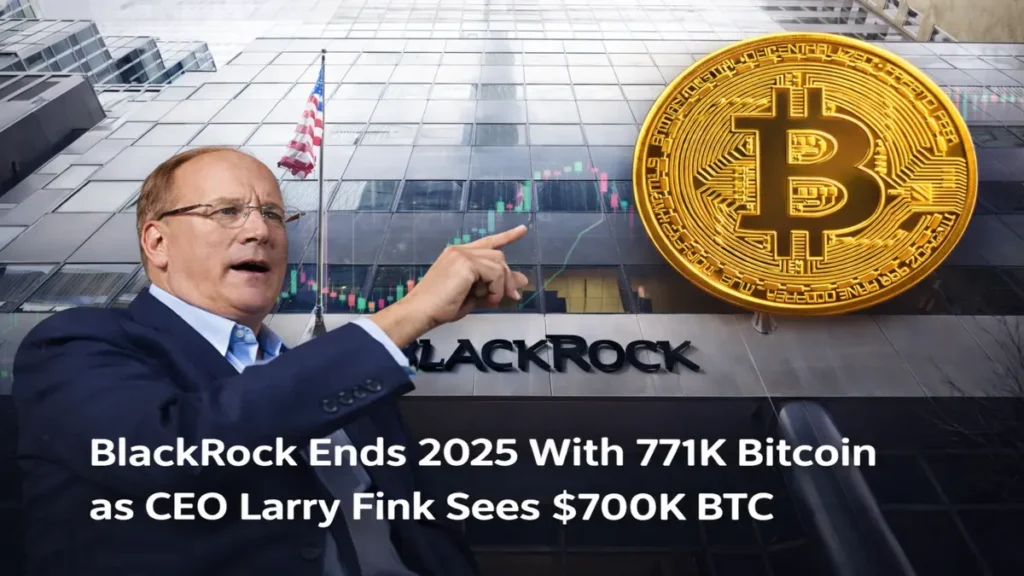
In a landmark year for institutional cryptocurrency adoption, global asset manager BlackRock closed 2025 holding an astonishing 771,000 Bitcoin (BTC) — one of the largest institutional Bitcoin positions ever reported. Alongside this accumulation, BlackRock CEO Larry Fink has publicly suggested a long-term price target for Bitcoin as high as $700,000 per BTC, signalling growing confidence in the asset’s future potential.
This development has ignited renewed discussions about Bitcoin’s role in global finance, institutional portfolios, and its evolving market structure.
Table of Contents
📊 BlackRock’s Bitcoin Position: By the Numbers
| Metric | Value |
|---|---|
| Bitcoin Held by BlackRock | 771,000 BTC |
| Approximate Value (End of 2025) | ~$67.5 billion (via IBIT) |
| Source of Holdings | BlackRock’s iShares Bitcoin Trust (IBIT) ETF |
| Growth Since Mid-2025 | Significant increase in BTC holdings |
Figures based on recent institutional reporting and ETF data.
What This Means
BlackRock’s Bitcoin stash positions it as one of the most influential institutional holders. For perspective:
- 771,000 BTC represents a significant portion of institutional Bitcoin appetite.
- BlackRock’s Bitcoin accumulation is largely tied to spot Bitcoin ETF inflows, the preferred vehicle for regulated traditional investors.
This accumulation reflects deepening confidence among institutional players — a key milestone for Bitcoin’s legitimacy in mainstream finance.
💡 Larry Fink’s $700,000 Bitcoin Scenario Explained
Larry Fink, CEO of BlackRock, has expanded his views on Bitcoin dramatically over recent years. Once sceptical, Fink now considers Bitcoin not just an asset but a potential store of value akin to “digital gold.”
Why $700K?
Fink’s bullish hint is grounded in a thought experiment:
If institutional investors allocated as little as 2%–5% of global portfolios to Bitcoin, the market dynamic could shift drastically — potentially driving BTC to $700,000 or more.
This scenario isn’t a prediction — it’s a market hypothesis, but one rooted in real institutional allocation considerations.
“If everyone adopted a small Bitcoin allocation, we could see extraordinary price effects,” — paraphrased from Fink’s commentary. Investing.com India
📈 Why Institutional Adoption Matters
1. Legitimacy & Market Confidence
A heavyweight like BlackRock entering the Bitcoin space at scale removes a significant layer of scepticism.
With asset managers, pension funds, and sovereign wealth funds closely watching, Bitcoin’s perception as an asset class is shifting.
2. ETF Inflows = Real Capital
Unlike derivatives or leveraged positions, Bitcoin held via ETFs is backed by real assets. This strengthens:
- Market liquidity
- Price discovery
- Loss of reliance on exchange-based holdings
BlackRock’s IBIT ETF, for example, saw extensive inflows during 2025, boosting its AUM and trading profile.
3. Portfolio Diversification
Institutional investors often cite Bitcoin’s limited supply (21 million) and decentralised nature as diversification tools against inflationary pressures — similar to gold but with digital utility.
⚠️ Risks and Considerations
Even with strong institutional interest, several factors could temper Bitcoin’s trajectory:
- Volatility: BTC historically experiences sharp price swings.
- Regulatory Landscape: Future legislation could affect adoption curves.
- Market Concentration: Large holders could influence price dynamics.
Investors should always conduct independent research and consult financial professionals. This article is educational and not financial advice.
Conclusion
BlackRock’s accumulation of 771,000 Bitcoin at the end of 2025 — coupled with CEO Larry Fink’s contemplation of a $700,000 BTC valuation — underscores a pivotal moment for institutional interest in cryptocurrency. While price targets remain speculative, the sheer level of engagement from major institutional players represents a deeper structural shift in how Bitcoin is perceived and utilised across global financial markets.
Whether Bitcoin will reach such lofty price levels is still up for debate, but the narrative has clearly evolved — from niche digital curiosity to a serious contender in diversified institutional portfolios.
Frequently Asked Questions (FAQs)
-
How much Bitcoin does BlackRock hold as of the end of 2025?
BlackRock reportedly closed 2025 with approximately 771,000 Bitcoin (BTC) under management, primarily through its spot Bitcoin ETF products. This makes it one of the largest institutional holders of Bitcoin globally.
-
How does BlackRock own Bitcoin?
BlackRock does not typically buy Bitcoin directly for its corporate balance sheet. Instead, Bitcoin is held on behalf of investors through regulated investment products, mainly spot Bitcoin exchange-traded funds (ETFs), such as the iShares Bitcoin Trust.
-
Why is BlackRock’s Bitcoin holding significant?
BlackRock is the world’s largest asset manager, overseeing trillions of dollars in assets. Its large Bitcoin exposure signals strong institutional acceptance and helps legitimize Bitcoin as an investable asset class for traditional investors.
-
Did Larry Fink really say Bitcoin could reach $700,000?
Larry Fink discussed a hypothetical scenario in which Bitcoin could reach $700,000 if institutional investors allocate even a small percentage of their portfolios to the asset. This was not a price prediction, but a long-term market scenario based on adoption dynamics.
-
What factors could push Bitcoin toward $700K according to this view?
Key factors include:
Increased institutional adoption
Limited Bitcoin supply (capped at 21 million BTC)
Growing demand for inflation hedges
Wider use of regulated Bitcoin ETFs -
Does BlackRock control the Bitcoin it holds?
No. The Bitcoin held through ETFs is stored with regulated custodians, and ownership remains with ETF investors. BlackRock acts as the asset manager, not the owner of the underlying Bitcoin.
-
Could BlackRock’s Bitcoin holdings affect the market price?
Large institutional inflows can impact liquidity and demand, but Bitcoin’s price is still influenced by multiple factors, including global macroeconomic conditions, regulation, and retail participation.
-
Is BlackRock bullish or cautious about Bitcoin?
BlackRock maintains a measured stance. While it recognizes Bitcoin’s potential as a store of value and diversification tool, it also acknowledges risks such as volatility and regulatory uncertainty.
-
Is Bitcoin now considered “digital gold” by institutions?
Many institutions, including BlackRock executives, have compared Bitcoin to digital gold due to its scarcity and independence from central banks. However, Bitcoin remains more volatile than traditional gold.
-
Is this article financial advice?
No. This article is for informational and educational purposes only. It does not constitute financial or investment advice. Readers should conduct their own research or consult licensed financial professionals before making investment decisions.